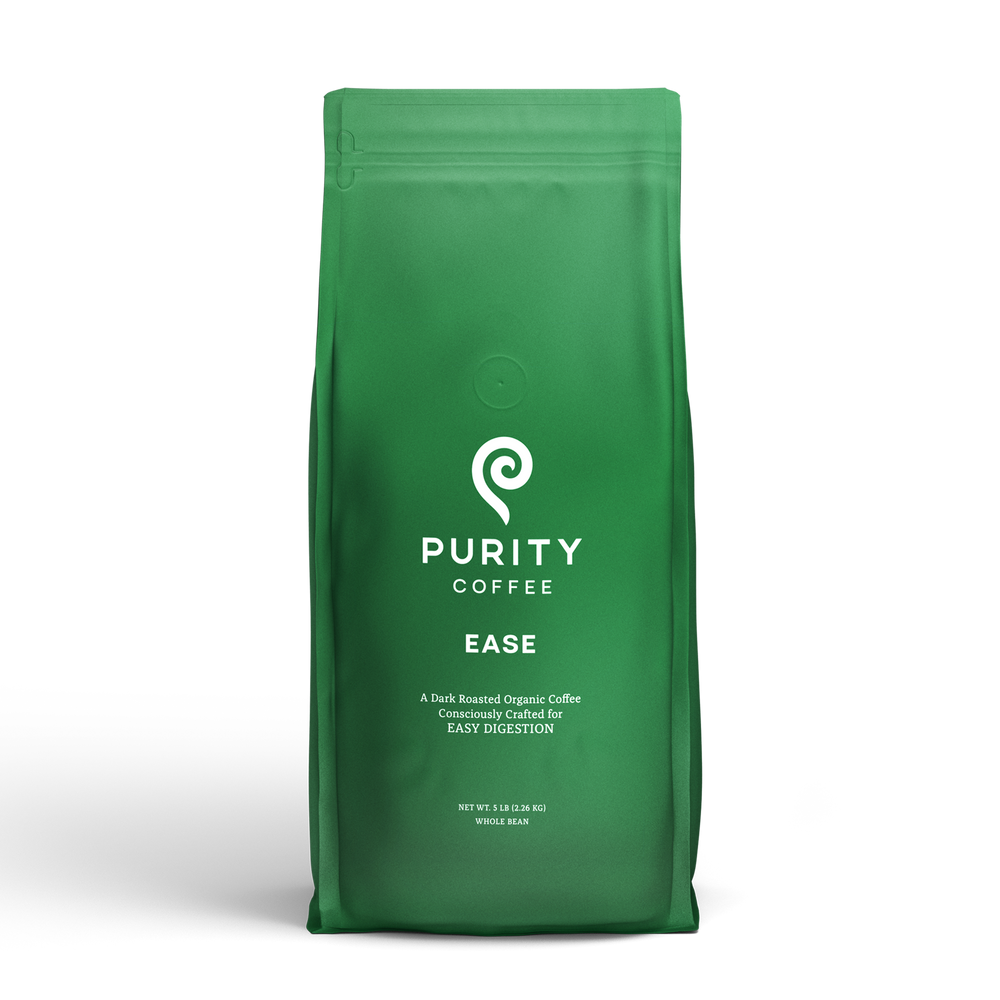
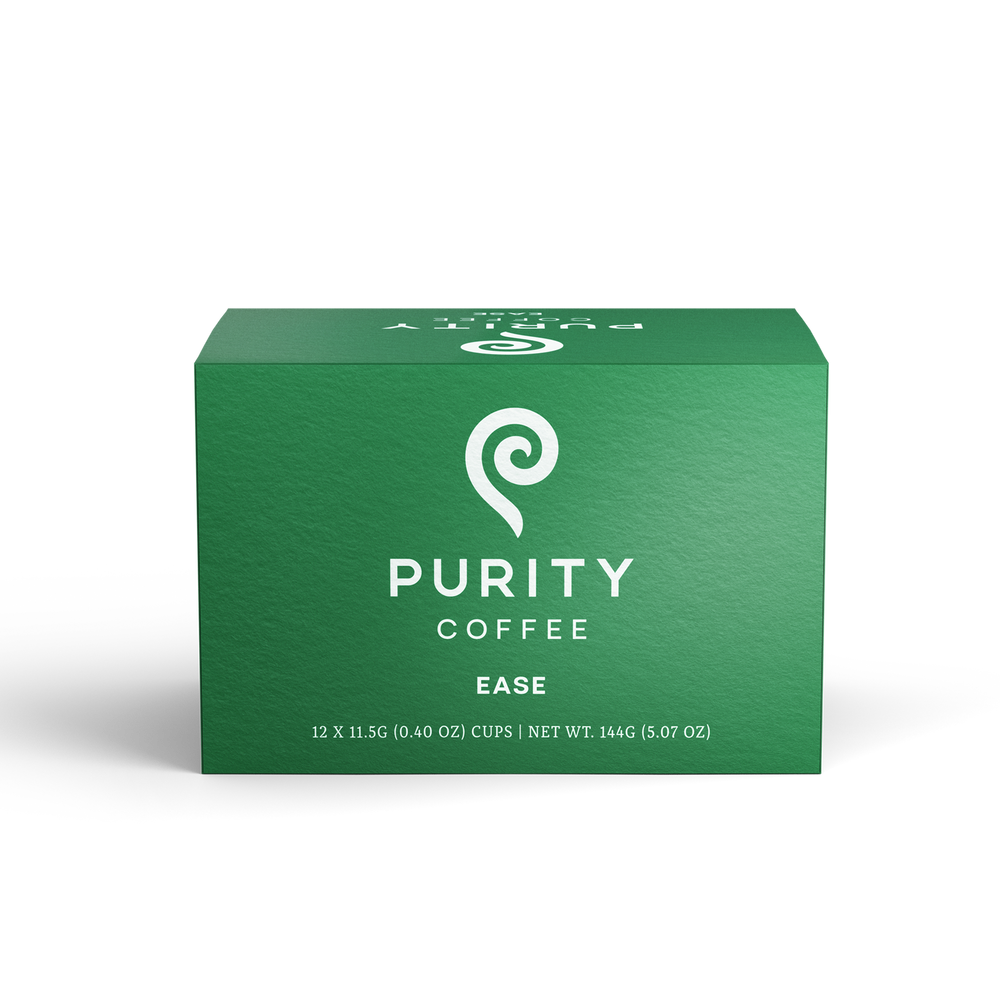
EASE COFFEE
At Purity Coffee®, we continue looking for the best coffees and researching ways to make our coffee healthier. We want consumers to have more choices in coffee to meet their health goals. The deeper we go, the more we understand that coffee is extremely complex and that various beneficial compounds can be created and destroyed at different roast levels.
It is not roasted so dark as to produce unhealthy levels of PAH because we take the coffee out before it reaches the temperature cited in the scientific literature, where PAH begins to form rapidly. Our dark roast follows a profile laid out in the scientific literature and hits several points that have been proven to be critical. Generally, throughout the literature, dark roast appears to be an appropriate choice for individuals with digestive issues and seems to have positive effects on the brain.
When comparing Purity Dark Roast to Purity Original, here are a few points to consider:
1. Because of the high content of chlorogenic acids, coffee is considered the most important contributor to antioxidant intake in many populations. Purity EASE still has antioxidant capacity, but the total CGA is about half the original (FLOW). On the other hand, high chlorogenic acids may stimulate gastric fluid secretions in some people, and for these people, a darker roast may be a better choice.
2. After being formed, acrylamide tends to decrease as roasting progresses. Purity EASE has even lower acrylamide than Purity FLOW.
3. Purity Dark Roast coffee does not come close to PAH temperatures. We do not get close to either an Italian Roast or French Roast as shown in the color chart below. So our dark roast is actually a dark-medium roast.
There are many ways roasters describe a coffee's color, and most terms are not precise, but rather suggestive.
Purity FLOW is a medium roast, which is a bit darker than the industry's sample roast level to evaluate (or "cup") specialty coffee. Purity EASE is darker than medium, and what some might say is a "Full City" roast. It is not as dark as what many consider Italian or French roast.
Melanoidins are what make coffee (and other foods) brown when roasted, baked or toasted. They are formed during the Maillard reaction, when certain sugars and amino acids combine at high temperatures and low water activity. They may be considered bioactive compounds (Bekedam et. al. 2008). Melanoidin production is directly related to how much antioxidant is made during roasting. The longer we roast, the more intermediate- and high-molecular-weight melanoidins are made. The following impacts and actions are associated with melanoidins: antioxidant activity, metal-chelating, antibacterial, and prebiotic functionality.
Coffee melanoidins may act as soluble fiber, enhancing immune-stimulating properties and contributing to reducing the risk of colon cancer. This likely happens by decreasing colon inflammation through improved microbiota balance (prebiotic effect) and by increasing the elimination rate of carcinogens through higher colon motility (urge to use the bathroom) (Vitaglione et al. 2012; Moreira et al. 2015; Fogliano & Morales 2011).
Coffee melanoidins do not seem to be absorbed in humans, but they can function as an antioxidant dietary fiber with an overall antioxidant capacity via embedded low molecular compounds. Melanoidins can act like a ‘sponge’ for free radicals in the gut. This improves the reduced or oxidized glutathione balance in the colon. Glutathione is an antioxidant produced in our cells (Garsetti 2000).
There are additional benefits of coffee melanoidins in the gut: They may promote the growth of a beneficial colon microbiota, affecting inflammatory pathways in the colon and liver (Sales et al. 2019). Oddly, the antioxidative structures formed in coffee melanoidins are similar to vitamin E. These appear to activate their scavenging properties gradually (Bekedam et al. 2008).
Researchers looked at the antioxidant activity of melanoidins extracted from various coffees. Some found that the radical-scavenging ability of coffee melanoidins was higher in dark-roasted coffee, while others found that it was the same no matter how much the coffee was roasted (Tagliazucchi et al. 2010).
In addition to radical scavenging, coffee melanoidins are able to chelate transition metal ions; that is, they can bind Zn2+, Cu2+, and Fe2+. Metal-chelating ability is key to inhibiting lipid peroxidation, among other benefits (Takenaka et al. 2005; Morales et al. 2005). Increasing evidence shows that oxidized lipids, advanced lipid oxidation end products, and lipid peroxidation play a major role in developing most oxidative stress-related diseases. Lipid peroxidation occurs in all human neurodegenerative diseases, such as Alzheimer’s disease, Parkinson's disease, and even atherosclerosis (Tagliazucchi et al. 2010).
Finally, coffee melanoidins seem to have a protective effect on liver steatosis in obese rats, which suggests that the melanoidins in coffee may influence liver fat and functionality. Glutathione may be involved (Vitaglione et al. 2012).
References: Vitaglione, 2012; Moreira, 2015; Fogliano and Morales, 2011; Sales, 2019.
Chlorogenic acid lactones (CGL) are bitter compounds with antioxidant capacity created during the coffee roasting process from the dehydration of chlorogenic acids (CGA). The maximum amount of CGL in roasted coffee represents approximately 30% of the available original CGA amount (Farah et al. 2005). CGA is shown to have the following impacts and actions: antioxidant activity, possible anti-opioid activity, hypoglycemic effects, and potential effects on brain function independently of the pharmacological effects of caffeine.
CGL exhibits opiate receptor-binding activity with characteristics similar to those of opiate antagonists and can reverse morphine-induced analgesia in mice. However, acute pharmacologic effects are unlikely with normal coffee consumption. Like chlorogenic acids, these compounds are partly absorbed (Farah & de Paula 2018).
After contact with the alkaline pH of human digestive fluids, part of the lactone was converted into caffeoylquinic acid. So, it is likely that a lot of the lactones that are consumed in the beer will change back into their original chlorogenic acid forms during digestion, which will indirectly increase the amount of chlorogenic acid that is taken in (Farah 2013).
It has been found in a mouse model that the major chlorogenic acid affects spontaneous locomotor activity, suggesting that it or a derivative could pass the blood-brain barrier. The chlorogenic acid lactones are less polar than their parent compounds and should be more permeable to the blood-brain barrier (De Paulis et al. 2004). One study showed a significant correlation between the levels of chlorogenic acid lactones in coffee and neuron cell survival. This suggests that chlorogenic lactones might contribute to the increased protective effects against H2O2-induced death of neuron cells (Chu et al. 2009).
References: Farah, 2005 & 2013; Díaz-Rubio, 2007. (Note: A dark roast mixture was used in this study); Sales, 2019.
Roasted coffee is the major known food source of norharman and harman β-carbolines. Considered mostly neuroactive substances, β-carbolines show a wide spectrum of reported pharmacological and neuroactive actions. They can bind to receptors in the brain, including opiate receptors, and they frequently act as inhibitors to regulate neurotransmitters. So far, only norharman and harman β-carbolines have been reported in coffee (any reference in this review to β-carbolines refers to only these two). Their health effects are being extensively studied. The following impacts and actions are associated with β-carbolines: antioxidant activity, possible anti-opioid activity, hypoglycemic, and antidepressant. Reduced rate of development of Parkinson’s disease (Ascherio 2004).
Norharman and harman are potent competitive and reversible monoamine oxidase (MAO) inhibitors in both rats and humans. The high amounts of these β-carbolines in roasted coffee place them among those at the top of the list for compounds with probable influence on Parkinson’s disease course (Casal 2015) Amounts of harman and norharman are very low in green coffee and increase significantly during roasting, but in a variable way. It is indicated that a darker roasted coffee will be higher in harman and norharman and generally speaking, norharman increases during roasting and decreases after 240°C (464°F) (Casal 2015; Gomes 2006).
References: Casal, 2015; Rodrigues, 2019.
Trigonelline is a plant hormone, one of the more abundant sources of nitrogen in green coffee, and a product of niacin metabolism. Green coffees contain about 1% trigonelline, of which 50–80% is degraded upon roasting; it breaks down to niacin, or nicotinic acid and N-methylpyridinium at higher temperatures, as well as into volatiles such as pyridine and pyrazines. Trigonelline has the following effects and actions: it is an antioxidant, it fights tumors and cancer, it stops the growth of cholesterol deposits, it kills microbes, lowers blood sugar, and lowers cholesterol.
Niacin (nicotinic acid) is essential for specific oxidation-reduction reactions in the body. At dark roast levels, trigonelline converts to higher niacin levels. This niacin is highly bioavailable in coffee beverages (Trugo 2003).
During roasting, the amount of trigonelline keeps going down while the amounts of nicotinic acid and N-methylpyridinium keep going up. Up until the dark-medium roast, which is similar to the Purity Dark Roast, N-methylpyridinium is the main thermal product.
Trigonelline plus chlorogenic acids reduced early glucose and insulin responses, which was shown to help prevent type 2 diabetes (Viera 2019). Trigonelline plus nicotinic acid helps control liver enzymes, which is linked to stopping the buildup of triglycerides and stopping diabetes from getting worse.
Antioxidant enzymes work better and lipid peroxidation goes down in the pancreas when tribugonelline is present (Verzelloni 2010). Lipid peroxidation is generally described as a process under which oxidants such as free radicals attack lipids, especially polyunsaturated fatty acids.
References: Trugo, 2003.; Farah, 2005 & 2009.
N-methylpyridinium is formed during roasting from trigonelline as a non-volatile degradation product. While small amounts of trigonelline and nicotinic acid are present in many foods other than coffee, the occurrence of N-methylpyridinium in our daily diet seems to be restricted to roasted coffee (Viera 2019).
Even though it is found in smaller amounts than CGA, N-methylpyridinium has the following effects and actions: it is an antioxidant; it lowers the amount of gastric acid produced, which may help with weight control; it may help fight cancer (possibly colon cancer); and it protects DNA.
Nrf2 is thought to be the master regulator of oxidative stress, and CGA and N-methylpyridinium were found to activate it. Nrf2 represents one of the main cell defense mechanisms and major regulators of cell survival. N-methylpyridinium represented an even more potent extract in vitro and in vivo than CGA (Boettler 2011).
It was shown that N-methylpyridinium increased activity in the liver, which helped get rid of many genotoxic carcinogens. Researchers also found that plasma antioxidant activity went up a lot. This suggests that N- methylpyridinium may play a big role in how well coffee protects against reactive oxygen species (ROS) (Al-Serori 2019). ROS are free radicals, or unstable molecules, that contain oxygen and easily react with other molecules in a cell. A buildup of reactive oxygen species in cells may cause damage to DNA, RNA, and proteins and may cause cell death (Ref: https://www.cancer.gov/).
References: Rubach, 2014; Kotyczka, 2011; Boettler, 2011; Pahlke, 2019 and Schipp 2018.