


 About: FLOW
 About: EASE
 About: CALM
 About: PROTECT
 About: BALANCE





Maybe you’ve already heard the news that drinking coffee is actually one of the healthiest choices you can make all day. But with all the coffee options that are vying for your attention, how do you know what to look for to get the healthiest blend possible? For many, starting with organic ground coffee is the best way to ensure both purity and health benefits. Others also value pure organic cold brew coffee as a way to combine convenience with maximum antioxidant potential.
It’s all about antioxidant content.
In a 2006 survey of US foods (Halvorsen et al.), brewed coffee had one of the higher measured antioxidant capacities per serving among commonly consumed items. That includes the much-touted superfoods like kale, dark chocolate, blueberries, and acai berries. Most people who drink coffee drink it every day, so your daily coffee is already a meaningful source of these compounds in most diets. Choosing certified organic coffee means synthetic pesticides were prohibited in production; we also lab test for residues and publish the results. Buy flow coffee to experience how careful sourcing and roasting can help preserve these antioxidants in every cup.
"Coffee consumption was associated with reduced risk of total mortality (3-4% lower mortality with 1 cup/day), especially cardiovascular mortality.” 2015 Dietary Guidelines Advisory Committee
Antioxidants, mainly chlorogenic acids, are the compounds in coffee that researchers study most.
Over the past few decades, research has slowly revealed the incredible truth about coffee’s health effects. Researchers have studied coffee drinkers' health across many large population studies. Those studies report associations, not proof that coffee prevents any condition. Multiple laboratory studies have gone on as well to determine just what it is about coffee that makes it so good for us. The results are that it’s all about active antioxidants, especially compounds called chlorogenic acid, or CGAs. In fact, many people now specifically seek out chlorogenic acid in coffee because of its strong link to protective health benefits. Options like balance coffee highlight how sourcing and preparation can amplify those antioxidant effects in meaningful ways.
As we live busy lives on a bustling planet, different factors can put stress on our bodies—from our choices of what to eat and drink to the very air we breathe. These stressors create excessive buildup of the byproducts of oxygen and nitrogen reactions in our bodies to produce compounds called free radicals. Nobody can completely avoid free radicals since they are everywhere, but too many free radicals can lead to health problems in the long run. Choosing antioxidant-rich options like premium decaf coffee can help counteract these effects, as free radicals tend to build up in the body’s cell membranes, even at the most basic level of DNA, to create oxidative stress and even change the makeup of cells.
Oxidative stress is one of many factors researchers study in relation to chronic disease.
So everything from pollution, a nitrogen and oxygen rich environment, and UV radiation, as well as dietary elements like low quality food and alcohol increase the number of compounds in the body that can damage our cells. These free radicals damage lipids that give us healthy skin and brain tissue, causing things like wrinkles and decreased cognitive function (aka., premature aging!). They build up on the walls of blood vessels and lead to cardiovascular disease. They interfere with the process of cell reproduction, which can lead to growth of cancerous cells.
Antioxidants counter the development of free radicals within the body. They carry out a process called free radical scavenging, which means they come through the body tissues and consume free radicals. This means that rejuvenating effects of correctly roasted coffee doesn’t just come from the caffeine that wakes you up when you’re sleepy. By drinking healthy coffee, you’re restoring your cells and protecting them from the damaging (yet hard-to-avoid) effects of daily life.
Antioxidants fight inflammation
So what exactly do these free radicals--that antioxidants fight against--actually do inside your body? That oxidative stress caused by free radicals manifests in the body as chronic inflammation.
Scientists find that chronic inflammation plays a large part in contributing to the development of certain diseases and disorders (a process called pathogenesis). Many times, that prolonged inflammation actually causes the health problem in the first place.
For the record, inflammation itself isn’t necessarily a bad thing. In fact, we would not be able to heal from injuries if it weren’t for acute inflammation. When you cut yourself, for example, proteins called cytokines swarm the area to encourage swelling and send a message to the rest of the body. As the area swells, blood vessels become more permeable so they’ll accept immune cells and hormones that will help get rid of any germs or foreign substance in the wound area that could cause life-threatening infections.
Everyone expects some initial swelling and inflammation when an injury first occurs. But if you’ve been sitting there with an ice pack for a while and the swelling isn’t going down, you might start to get a little worried that the thing that your body is fighting against won’t go away.
With chronic inflammation, the threat is that oxidative stress, which keeps damaged cell walls in a state of constant emergency. The difference is, it’s not happening on the surface of your skin, easy to track with your eyes. Often happening in parts of your body that you can’t see, and manifests in aches, pains, or diseases that you don’t see coming until they’ve done a lot of damage.
Chronic inflammation is an active research area, and scientists are studying whether dietary antioxidants play a role.
Andersen et al.’s study published in 2006 verified findings from previous studies that antioxidant therapy reduced inflammatory responses in live tissue. They went on to apply those findings to the coffee intake of postmenopausal Iowan women. In the Iowa Women's Health Study, coffee intake was associated with lower mortality from inflammatory and cardiovascular causes. The authors suggested antioxidants as one possible explanation.
Coffee is one of the largest contributors of polyphenols to the typical Western diet simply because so much of it is consumed.
How coffee compares with other foods in the surveys
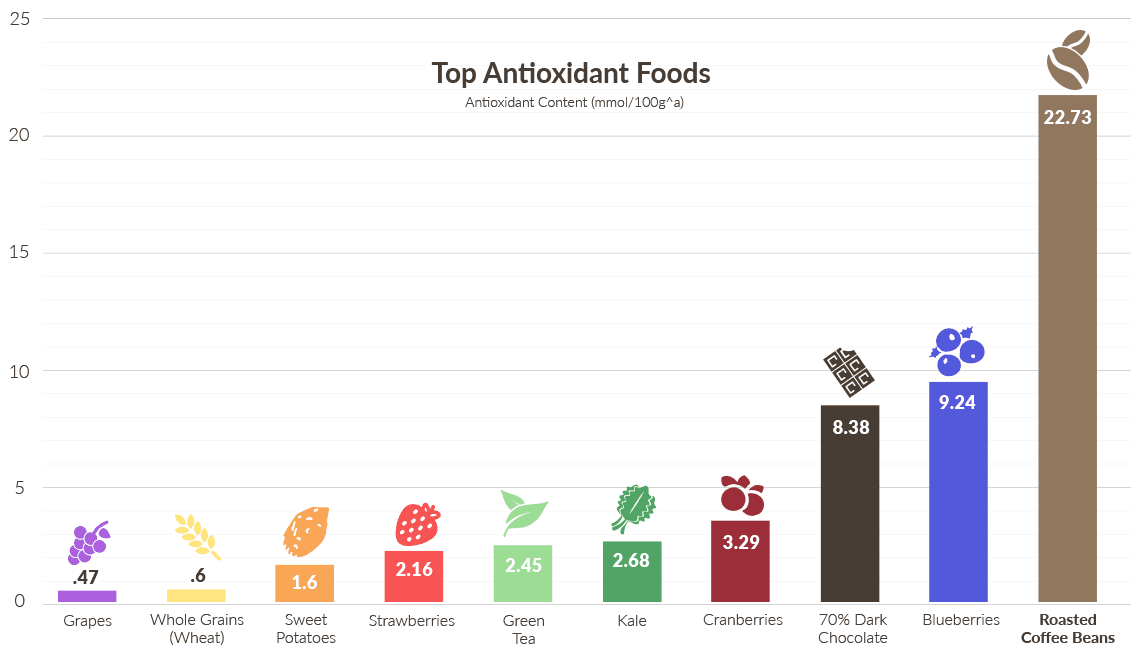 Would you believe that a cup of coffee contains more antioxidants than a shot of kale juice? In an exhaustive study of the antioxidant content of hundreds of foods, beverages, and supplements, the coffee brewed from roasted arabica beans demonstrated up to 22 mmol/100 grams of antioxidants. This is compared to 4 mmol/100 grams of antioxidants in red curly kale. The only substances that contain higher concentrations of antioxidants, are spices and supplements. For example, there are 317.96 mmol/100 grams of cloves, but you wouldn’t consume 100 grams of cloves in one sitting (and we would advise you against trying to do so).
Coffee contains certain types of antioxidants called Chlorogenic Acids (aka CGAs). These compounds are especially good at scavenging free radicals and interrupting free radical chain-reactions. That means they consume free radicals and prevent damage that these molecules do to delicate cell membranes in the human body by stopping them in their tracks. According to a study by Yashin et al., “A cup of coffee which contains 10 g of roasted coffee beans may have 15 to 325 mg of chlorogenic acids.”
When we look at what people are already in the habit of eating and drinking every day, it’s clear that coffee is the healthiest choice many of us can make. Now imagine if you could slightly tweak that habit to dial the health benefits up to 11. Well good news: You totally can, and we’re going to tell you how.
The most antioxidant-rich coffee hits a roasting sweet spot.
So how do you know that there are as many antioxidants as there can possibly be in your morning mug? The secret is finding the proper roasting profile. And that can be a tricky prospect.
Research has shown that the level of CGAs varies between different coffee varieties, and while green coffee beans have high levels of antioxidants, roasting creates acrylamide (it is not present in green coffee), and the roast degree affects how much forms. And more than that, for all the health benefits magazines and health “gurus” attribute to green coffee beans, some roasting can actually improve the antioxidant levels in coffee. Researchers in the Prifitis et al. lab study tested four different varieties of coffee bean to review antioxidant activity at every level. For all four varieties of beans in this experiment, there was a significantly higher level of antioxidant activity in roasted beans over green beans. The roasting process created brand new active antioxidant compounds in the beans than existed in the green beans.
Acrylamide safe coffee highlights the importance of balance, since the CGA content in roasted coffee beans hits a point of diminishing returns as roasting proceeds Furthermore, roasting too heavily creates problems that outweigh coffee’s benefits and creates carcinogens called PAHs. A study by Kotyczka et al. revealed that medium roast coffee had the highest degree of antioxidant activity of all in an “in vitro” sample (outside of a living organism). This and other studies have also proven that roasting eliminates phenolic compounds, like CGAs, that are present in green beans, and too dark of a roast will burn off a lot of those helpful antioxidants. For anyone concerned about balance, low acrylamide coffee provides additional reassurance alongside strong antioxidant potential.
It’s clear, then, that using roasting to maximize the antioxidant level of a particular type of coffee bean requires that the roaster test the beans’ chemical makeup. What’s really necessary is for someone who understands the importance of the right balance between the green bean and a darker roast to control the mechanics of the process.
How Purity Coffee measures chlorogenic acids
We test green coffee lots for chlorogenic acids and trigonelline before purchase and monitor the roast curve on every batch to protect those compounds. We know that there are differences between batches, and we take that into account when finding that sweet spot between too light and too dark of a roast. Every time.
Purity has also invested in the science of coffee. Between 2016 and 2018 we commissioned chlorogenic acid testing of 49 retail coffees; the results are on our lab results page, alongside our own current numbers, so you can compare for yourself.
So when you’re wondering what to look for when you select your bag of beans, look for a coffee committed to maximizing antioxidant content. Look for a coffee company that publishes its lab results. We do.
This article summarizes published research on coffee in general. It is for educational purposes and is not a claim that any Purity Coffee product diagnoses, treats, cures or prevents any disease. It is not medical advice.
1 comment


Thank you for publishing this wonderful article.
For years I have been a coffee drinker. For some reason stopped drinking coffee early in the morning. Some weeks ago my systolic blood pressure was close to 200 when I got out of bed in the morning. After recording my Blood Pressure during the course of a day I realized a cup of coffee was all I needed to return my BP to its normal rate.
Leave a comment